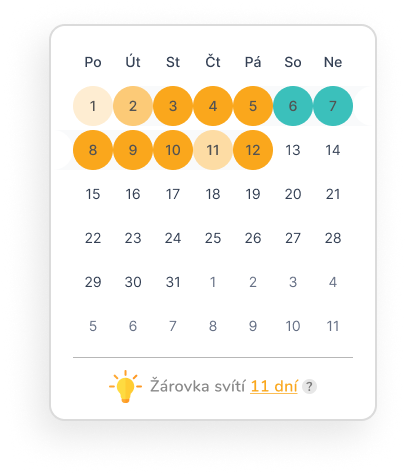

Denní trénink obsahuje 5 cvičení, která dohromady zaberou přibližně 15 minut – tento čas je ideální pro pravidelnost i viditelné výsledky.
Every completed exercise activates a new part of your neural network.
Once you complete all 5 exercises, the light bulb lights up – a symbol of successfully completed training.
Try to keep the bulb lit as long as possible – every additional day helps your mind stay active and in shape.
The calendar tracks your daily training activity:
1 exercise = 20% intensity
5 exercises = 100% intensity
12345
Regular short training supports neuroplasticity of the brain, improves attention, memory and mental flexibility.

And one more interesting fact: some schizophrenics are better at the flanker task than healthy people, while people suffering from Parkinson's disease make many errors in the task – all the more so when they know their training is time-limited.
The Flanker task was devised by psychologists Barbara and Charles Eriksen in 1974. The goal of this task is to focus on one relevant piece of information while suppressing all other (distracting) information in the surrounding area.
The original version of the test used letters. In a row made up of several letters, there was always just one that you had to focus on. The others were distractors. The instruction read: if the letter K appears in the middle of the row HHHHHH (HHHKHHH), you say "right". When the letter C appears (HHHCHHH), you say "left". Reaction speed and error rate are measured.
Later, colours, symbols or arrows began to be used instead of letters. For example, our game Army Squadron is based on the flanker – regardless of the direction of the other fighter jets, you always determine the direction of only the one you see at the top of the triangle.
A number of experiments and studies attest to the fact that the flanker is not just an entertaining game but a genuine "brain booster". It has been demonstrated, for example, that people under the influence of alcohol or drugs have a much longer reaction time than when sober. This even led to the flanker being introduced into some driver tests.