American humanistic psychologist Abraham Harold Maslow made a lasting impression on postwar generations thanks to his theory of the hierarchy of needs (1943), which motivates all of our behavior and actions. Maslow believed that every person has the potential to achieve fulfillment in life; to do so, however, they must first overcome several obstacles by satisfying their lower-level needs. Contrary to the prevailing trend at the time, when psychological theories tended to focus on the “bad” in us, this was an interesting shift, and the theory could not go unnoticed.
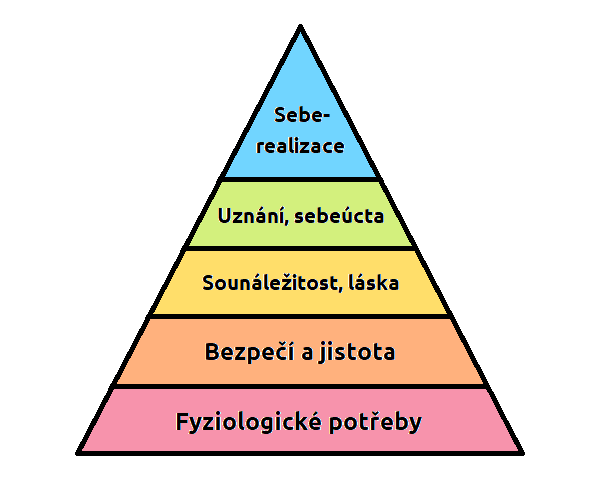
Maslow organized needs into an imaginary pyramid based on the intensity with which they press upon us. The lower levels contain needs that are essential for our individual and social survival. The higher levels are not necessary for survival, but they contribute to long-term satisfaction and develop our personal potential. The central principle of this theory is that we can only move up to the higher levels of the imaginary pyramid once our lower needs have been satisfied.
So which needs are we actually talking about? Let’s take a brief look at them:
-
Physiological needs - These are the most basic needs of all; it is their fulfillment that keeps a person alive. These are the needs that ensure the maintenance of our body’s equilibrium (known as homeostasis). This includes the need to eat, breathe, move, sleep, reproduce, excrete, or, for example, the need for sensory stimulation and pain relief. If any of these needs begins to go unmet, the body very quickly demands our attention and persistently signals the need to have that need met.
-
Safety and Security — Another strong need is the avoidance of danger and unknown or threatening stimuli. This need is fulfilled by seeking security, reliability, and stability. We can see this need being met when we secure our homes or purchase insurance. We seek security in matters related to our health, employment, or family.
-
Belonging and Love —the need that allows us to maintain relationships with family, partners, and friends. The desire for intimacy, the need to belong, to love, and to be loved. This also includes living in a community of people with whom we associate not merely for a sense of security, but precisely for a sense of belonging. This middle-level need protects people from loneliness, depression, and anxiety.
-
Recognition and Self-Esteem —this need stems from a person’s desire to be recognized both by others and by themselves. It might seem that recognizing oneself is simple, but achieving true and genuine self-esteem can be a lifelong process. That is precisely why this need is located near the very top of the pyramid. Not everyone succeeds in fulfilling this need.
-
Self-actualization —the need to develop one’s potential, abilities, and talents. The need for personal growth, the desire for knowledge, and aesthetic experiences. At the very top, Maslow envisioned yet another need: self-transcendence, or the spiritual need. Maslow defines self-actualized individuals as creative, spontaneous, free of prejudice, ethical, and independent of external authorities. Not everyone has what it takes to meet self-actualization needs. For those who do, the fulfillment of these needs usually comes only after middle age. According to Maslow, only 1% of people succeed in satisfying their growth needs.
Maslow further divided the five needs into two groups—deficiency needs and growth needs. Deficiency needs include Groups 1 through 4 and can be summarized as those that allow us to maintain our physical and mental well-being. Growth needs include the fifth group—self-actualization, that is, the development of potential, the desire for knowledge, spirituality, and aesthetics. They are called growth needs because they give us the opportunity to transcend ourselves.
The way we approach recognizing and satisfying our needs depends largely on the culture in which we live. That culture may prioritize some needs and neglect others (for example, consumerism—1—at the expense of spirituality—5—).
Criticism of the Theory
Maslow’s hierarchy of needs theory is sometimes challenged by examples in which an individual, despite unmet physiological needs, is capable of remarkable achievements. One example is the Jewish musicians in concentration camps, who, during their harrowing stay, composed magnificent orchestral works and had the opportunity to perform them together with other prisoners right in the camps. According to critics, these achievements—which fall under the category of growth needs—occurred without the fulfillment of any of the deficiency needs. This significantly undermines the hierarchical theory. Fortunately, there is an explanation for this example as well. In order for a person to create in a way that fosters self-actualization, psychophysical well-being at a given moment is not so much a necessity as the fact that the individual has had their basic deficiency needs met throughout their life. Thus, if someone experiences a peaceful childhood, with basic needs met, parental love, and respect from those around them (and, by extension, self-respect), they will acquire the prerequisites for successfully fulfilling their growth needs. A situation may then arise that turns all that is good into a catastrophe, but there are (and have been) individuals who grow despite such events.
You read about the mind. Start training it.
Mentem translates insights about brain function into short, measurable and fun training.